Structural Strengthening
Advanced Structural Strengthening & Load Enhancement Solutions in Mumbai & MMR
Structural strengthening is required when an existing building needs to improve load capacity, enhance safety, or restore structural performance beyond simple repair. At Structonix, we provide engineering-driven structural strengthening solutions for residential, commercial, and industrial buildings across the Mumbai Metropolitan Region.
We strengthen structures — not just repair them.
When Is Structural Strengthening Required?
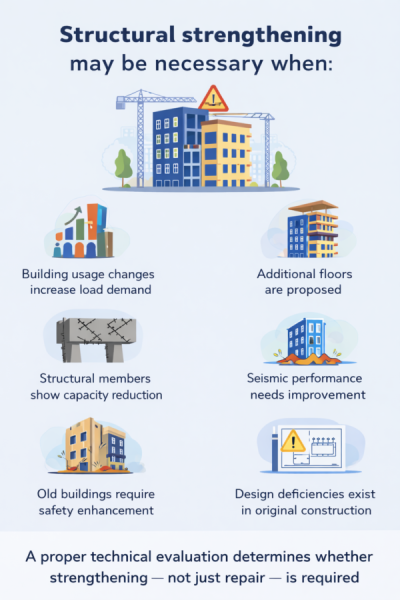
Structural strengthening may be necessary when:
Building usage changes increase load demand
Additional floors are proposed
Structural members show capacity reduction
Seismic performance needs improvement
Old buildings require safety enhancement
Design deficiencies exist in original construction
A proper technical evaluation determines whether strengthening — not just repair — is required.
Our Structural Strengthening Services
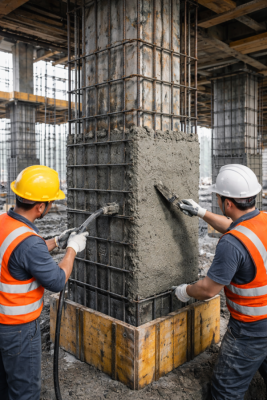
RCC Jacketing
RCC jacketing is one of the most widely used strengthening techniques for enhancing the load-carrying capacity of existing columns and beams. This method involves adding a reinforced concrete layer around the structural member along with additional reinforcement bars to improve axial, flexural, and shear capacity.
RCC jacketing is typically recommended when:
- Columns show reduced strength due to corrosion or deterioration
- Additional floors are proposed
- Load demand increases due to change in usage
- Structural capacity needs enhancement
The process includes surface preparation, installation of shear connectors, additional reinforcement placement, shuttering, and micro concrete or high-strength concrete casting under controlled supervision.
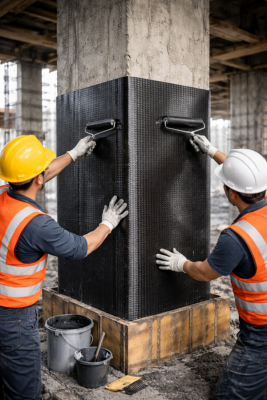
Carbon Fiber (FRP) Wrapping
Fiber Reinforced Polymer (FRP) wrapping is an advanced strengthening system used to enhance structural capacity without significantly increasing member dimensions or weight.
FRP systems are ideal for:
- Beam flexural strengthening
- Shear strengthening of beams and columns
- Confinement of columns
- Slab strengthening
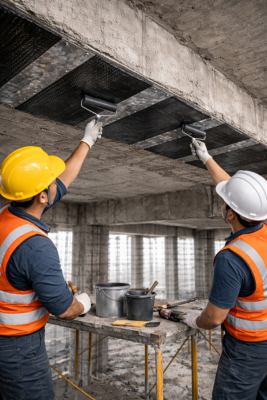
The method involves surface preparation, epoxy bonding, and application of high-strength carbon fiber sheets designed as per load calculations. FRP strengthening is fast, lightweight, and minimally intrusive, making it suitable for occupied buildings.
Steel Plate Bonding
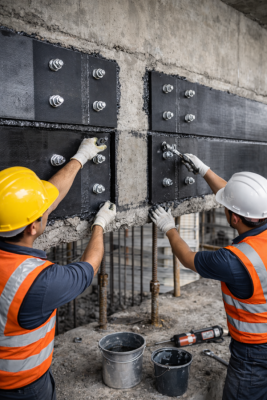
Steel plate bonding is used to increase flexural or shear capacity of structural elements by bonding steel plates to the tension zones of beams or slabs using high-performance adhesives and anchor systems.
This technique is effective when:
- Beam flexural capacity is inadequate
- Structural modifications require load enhancement
- Rapid strengthening is required
Proper surface preparation and anchorage detailing are critical to ensure composite action between existing concrete and steel plates.
Slab Strengthening
Slab strengthening is required when increased loading demands arise due to change in occupancy, addition of heavy equipment, or structural deterioration.
Methods may include:
- FRP strengthening
- Steel plate reinforcement
- Additional topping slabs
- Section enhancement techniques
The strengthening system is selected based on load evaluation and structural analysis to ensure safe performance under revised loading conditions.
Foundation Strengthening
Foundation strengthening is necessary when:
- Additional loads are introduced
- Differential settlement occurs
- Original foundation capacity is inadequate
- Structural modifications demand higher load transfer
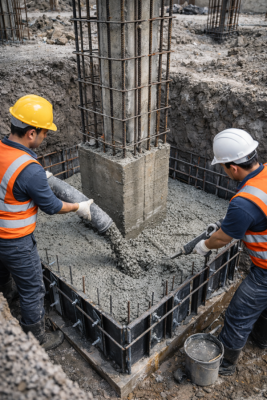
Solutions may include foundation enlargement, micro piling, underpinning, or load redistribution systems. Proper geotechnical evaluation and structural coordination are essential before implementation.
Why Choose Structonix?
Engineering-Led Strengthening Design
All strengthening solutions are based on structural evaluation, load calculations, and engineered methodology — not guesswork.
Execution-Focused Implementation
We are execution specialists. Our supervised site teams ensure strengthening systems are implemented precisely as designed.
Transparent BOQ & Methodology
Clear scope definition, material systems, and structured BOQ ensure complete transparency and cost clarity.
Proven Retrofitting Systems
We apply established strengthening systems such as RCC jacketing, FRP wrapping, and steel bonding techniques.
Integrated Waterproofing Support
Strengthening is integrated with waterproofing strategies to prevent future deterioration and corrosion.
Long-Term Structural Durability
Our focus is on extending building life and enhancing structural performance for decades — not temporary fixes.
Frequently Asked Questions – Structural Strengthening
What is structural strengthening?
Structural strengthening is the process of increasing the load-carrying capacity or performance of an existing structure using engineered techniques such as RCC jacketing, FRP wrapping, or steel plate bonding.
When is structural strengthening required instead of repair?
Strengthening is required when the structure needs improved load capacity, seismic resistance, or performance enhancement. Repair restores damaged elements, while strengthening enhances structural capacity beyond its existing condition.
What is RCC jacketing?
RCC jacketing involves adding reinforced concrete around existing columns or beams along with additional steel reinforcement to improve axial, flexural, and shear strength.
Does RCC jacketing increase column size?
Yes. RCC jacketing increases the cross-sectional dimensions of the structural member. This must be considered during design and space planning.
What is FRP wrapping used for?
FRP wrapping is used to strengthen beams, slabs, and columns by bonding high-strength carbon fiber sheets to the surface, increasing structural capacity without significantly increasing weight.
Is carbon fiber strengthening durable?
Yes. When properly designed and installed with quality epoxy systems, FRP strengthening provides long-term structural enhancement and corrosion resistance.
What is steel plate bonding in structural strengthening?
Steel plate bonding involves attaching steel plates to concrete members using high-strength adhesives and mechanical anchors to increase flexural and shear capacity.
Where is steel plate bonding commonly used?
It is commonly used in beams and slabs where additional flexural strength is required due to load increase or structural deficiency.
Why would a slab require strengthening?
Slabs may require strengthening when building usage changes, heavy equipment is added, additional floors are planned, or load demand exceeds original design capacity.
Can slab strengthening be done without major demolition?
Yes. Techniques such as FRP wrapping or steel plate bonding can often be applied with minimal structural alteration and disruption.
When is foundation strengthening necessary?
Foundation strengthening is required when additional loads are introduced, settlement issues occur, or original foundation capacity is insufficient.
What methods are used for foundation strengthening?
Common methods include foundation enlargement, underpinning, micro piling, and load redistribution systems depending on site and structural requirements.
Service Areas
Areas We Serve
We operate across: Mumbai (Western Suburbs, Central Suburbs & South Mumbai), Thane, Navi Mumbai, Kalyan-Dombivli, Mira-Bhayandar, Vasai-Virar, Panvel , Ulhasnagar, Bhiwandi-Nizamapur
Structural Retrofitting & Waterproofing Across Mumbai Metropolitan Region
Structonix provides structural retrofitting, structural repair, concrete rehabilitation, and advanced waterproofing services across the Mumbai Metropolitan Region (MMR).
With a strong execution-focused approach, we serve residential societies, commercial buildings, and industrial structures throughout the region.
Local Expertise in Urban & Coastal Conditions
Buildings in Mumbai and surrounding areas face unique challenges including:
- Coastal corrosion exposure
- High humidity and heavy monsoon conditions
- Aging residential societies
- Increasing load demands
- Water ingress and structural deterioration
Our repair methodologies are adapted to these regional conditions to ensure long-term durability and performance.