Seismic Retrofitting Services
Earthquake Strengthening & Seismic Structural Upgradation in Mumbai & MMR
Seismic retrofitting is the process of strengthening existing buildings to improve their performance during earthquakes. Many older structures were not designed to current seismic standards and may be vulnerable to lateral forces and structural failure.
At Structonix, we provide engineering-driven seismic retrofitting solutions designed to enhance structural resilience, improve ductility, and reduce risk during seismic events.
We strengthen structures to withstand dynamic forces — not just static loads.
Why Seismic Retrofitting Is Important ?
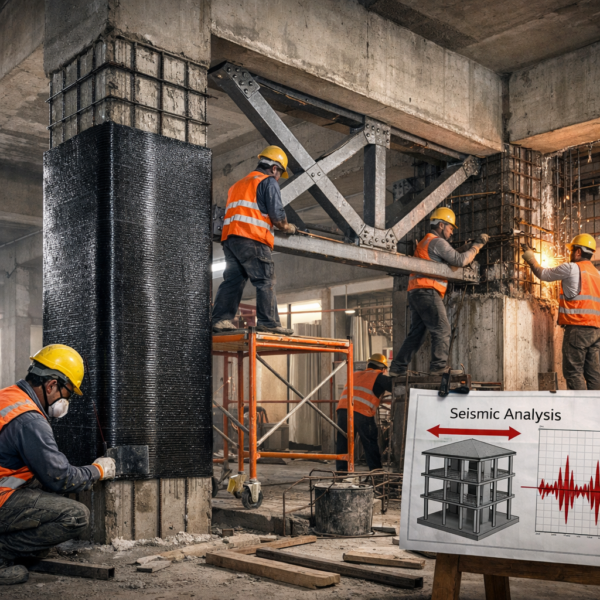
Buildings may require seismic strengthening when:
- Constructed under outdated design codes
- Located in moderate seismic zones
- Showing structural deficiencies
- Undergoing change in usage or load increase
- Experiencing beam-column joint weaknesses
- Lacking proper lateral load resistance systems
Seismic retrofitting reduces risk of catastrophic structural failure and improves occupant safety.
Our Seismic Retrofitting Solutions
Column Confinement Strengthening
Enhancing ductility and load resistance through RCC jacketing or FRP wrapping.
Beam-Column Joint Strengthening
Strengthening weak joints to improve lateral load transfer and prevent brittle failure.
Shear Wall Strengthening
Enhancing lateral stability by strengthening or adding shear walls.
FRP Seismic Strengthening
Using carbon fiber systems to improve confinement and shear resistance without major structural enlargement.
Foundation Strengthening for Seismic Loads
Upgrading foundation systems to safely transfer seismic forces to ground.
Structural Bracing Systems
Installation of steel bracing systems to improve lateral load resistance.
Our Seismic Retrofitting Methodology
Structural Condition Assessment
Comprehensive on-site inspection to evaluate structural health, material condition, and existing load-resisting systems before seismic analysis.
Seismic Vulnerability Evaluation
Assessment of structural deficiencies, weak joints, irregularities, and lateral force resistance gaps under earthquake loading conditions.
Load & Performance Analysis
Engineering evaluation of structural capacity under seismic forces to determine required strengthening measures and performance objectives.
Strengthening System Design
Design of engineered strengthening systems such as RCC jacketing, FRP confinement, bracing systems, or shear wall enhancement.
Controlled Execution & Supervision
Structured on-site implementation under professional supervision to ensure compliance with approved methodology and safety standards.
Quality Verification & Documentation
Final quality checks, performance verification, and detailed documentation to confirm structural resilience improvements.
Who Requires Seismic Retrofitting?
Residential societies (older than 20–30 years)
Commercial buildings with code deficiencies
Industrial structures
Educational institutions
Healthcare facilities
Buildings undergoing structural modification
Why Choose Structonix for Seismic Retrofitting?
✔ Engineering-led seismic evaluation
✔ Performance-based strengthening design
✔ Proven retrofitting systems (RCC jacketing, FRP, steel systems)
✔ Controlled execution
✔ Integrated structural + waterproofing support
✔ Long-term safety orientation
Improve Structural Resilience Before Risk Escalates
Seismic retrofitting is a proactive investment in structural safety and asset protection.
📞 Request Seismic Evaluation Today
📧 Get Technical Consultation
Frequently Asked Questions – Seismic Retrofitting
What is seismic retrofitting?
Seismic retrofitting is the process of strengthening an existing building to improve its ability to withstand earthquake forces. It enhances structural stability, ductility, and lateral load resistance.
Is seismic retrofitting necessary in Mumbai?
Mumbai falls under moderate seismic risk zones. While not a high seismic zone, older buildings constructed under outdated codes may benefit from seismic evaluation and strengthening to improve safety and resilience.
How is seismic retrofitting different from structural strengthening?
Structural strengthening improves load capacity for gravity loads, whereas seismic retrofitting specifically enhances performance under lateral earthquake forces and dynamic loading conditions.
Which buildings require seismic retrofitting?
Buildings that are over 20–30 years old, have design deficiencies, show beam-column joint weaknesses, lack adequate shear walls, or are undergoing structural modification may require seismic evaluation.
What methods are used in seismic retrofitting?
Common methods include RCC jacketing, FRP confinement, beam-column joint strengthening, shear wall enhancement, steel bracing systems, and foundation strengthening.
Will seismic retrofitting disrupt building occupants?
Most retrofitting works are planned in phases to minimize disruption. Depending on the scope, some temporary access restrictions may be required during strengthening works.
How long does seismic retrofitting take?
The duration depends on building size, complexity, and required strengthening systems. Small retrofitting works may take weeks, while full-building seismic upgrades may take several months.
How much does seismic retrofitting cost?
Costs vary based on structural condition, required strengthening techniques, and project scope. A detailed structural and seismic evaluation is necessary before providing a transparent BOQ-based quotation.
Service Areas
Areas We Serve
We operate across: Mumbai (Western Suburbs, Central Suburbs & South Mumbai), Thane, Navi Mumbai, Kalyan-Dombivli, Mira-Bhayandar, Vasai-Virar, Panvel , Ulhasnagar, Bhiwandi-Nizamapur
Structural Retrofitting & Waterproofing Across Mumbai Metropolitan Region
Structonix provides structural retrofitting, structural repair, concrete rehabilitation, and advanced waterproofing services across the Mumbai Metropolitan Region (MMR).
With a strong execution-focused approach, we serve residential societies, commercial buildings, and industrial structures throughout the region.
Local Expertise in Urban & Coastal Conditions
Buildings in Mumbai and surrounding areas face unique challenges including:
- Coastal corrosion exposure
- High humidity and heavy monsoon conditions
- Aging residential societies
- Increasing load demands
- Water ingress and structural deterioration
Our repair methodologies are adapted to these regional conditions to ensure long-term durability and performance.