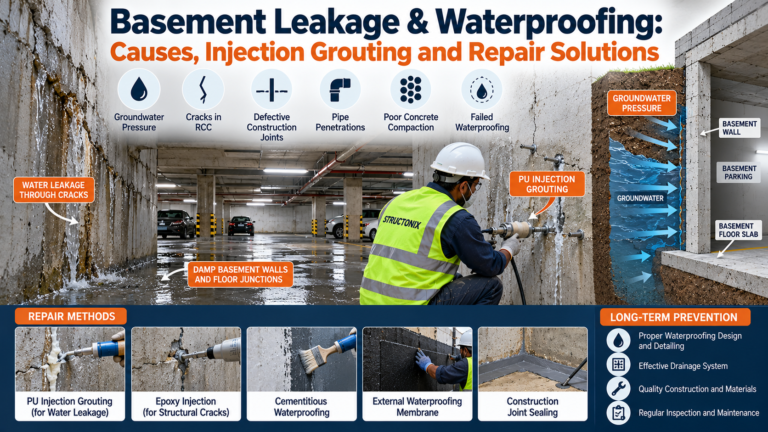
Basement Leakage & Waterproofing: Causes, Injection Grouting and Repair Solutions
Basement water leakage is a common problem affecting residential buildings, housing societies, commercial complexes, underground parking areas and industrial structures. Water entering through basement walls, floor slabs, construction joints or structural cracks can damage finishes, accelerate concrete deterioration and disrupt building operations.
In Mumbai, Thane and Navi Mumbai, heavy monsoon rainfall, groundwater fluctuations and inadequate drainage can increase the risk of water ingress into below-ground structures.
Effective basement waterproofing requires proper leakage diagnosis, identification of water-entry paths and selection of appropriate repair or waterproofing systems.
Injection grouting is one commonly used technique for controlling water leakage through cracks and joints. However, not every basement leakage problem can be solved by injection alone.
This guide explains the causes of basement leakage, PU and epoxy injection grouting, waterproofing methods, repair procedures, cost considerations and long-term preventive solutions.
1. Why Do Basements Develop Water Leakage?
Basement structures are generally constructed below the surrounding ground level and may be exposed to soil moisture, groundwater and water pressure.
Unlike exposed roof surfaces, basement walls and slabs often have limited accessibility from the external side after construction.
This makes leakage investigation and remedial waterproofing more challenging.
Common Basement Leakage Locations
- RCC retaining walls
- Basement raft and floor slabs
- Wall-to-floor junctions
- Construction joints
- Expansion and movement joints
- Pipe penetrations and service openings
- Tie-rod holes and formwork penetrations
- Lift pits and sump chambers
- Underground utility rooms
Important: The location where water becomes visible inside a basement may not be the original point of water entry. Water can travel along cracks, interfaces and concealed pathways before emerging at another location.
2. Common Causes of Basement Water Leakage
2.1 Hydrostatic Water Pressure
Groundwater surrounding a basement can exert hydrostatic pressure against retaining walls and floor slabs.
Where the waterproofing system is defective or discontinuous, water pressure can drive leakage through available openings.
2.2 Cracks in RCC Walls and Slabs
Concrete cracks may result from shrinkage, temperature movement, structural restraint, settlement, loading or other deterioration mechanisms.
Cracks extending through a concrete element may provide a pathway for groundwater penetration.
2.3 Defective Construction Joints
Construction joints are formed where concrete is placed in separate stages.
Inadequate joint preparation, ineffective waterstops, poor consolidation or defective joint detailing can create leakage pathways.
2.4 Failed External Waterproofing
Basement walls may be protected using external membranes or other waterproofing systems.
Mechanical damage, incomplete overlaps, improper terminations and poorly executed penetrations can compromise waterproofing continuity.
2.5 Wall-to-Floor Junction Leakage
The junction between a basement wall and raft or floor slab is a common location requiring careful waterproofing detailing.
Leakage may occur if waterstops are defective, omitted or improperly installed.
2.6 Pipe Penetrations
Plumbing, drainage, electrical and mechanical services frequently pass through basement walls and slabs.
Inadequate sealing around sleeves or penetrations can allow groundwater to enter the basement.
2.7 Honeycombing and Poor Concrete Compaction
Honeycombing occurs when concrete contains voids or areas of inadequate consolidation.
Significant interconnected voids may permit water penetration through the concrete.
2.8 Inadequate Surface and Ground Drainage
Poor site drainage, blocked external drains, defective stormwater arrangements and water accumulation around the building can increase moisture exposure and, in some conditions, hydraulic pressure.
3. Warning Signs of Basement Waterproofing Failure
Basement leakage problems may initially appear as minor damp patches before more extensive deterioration develops.
Common Basement Leakage Indicators
- Water dripping or flowing through RCC cracks
- Persistent damp patches on basement walls
- Water collecting at wall-to-floor junctions
- Efflorescence or white salt deposits
- Peeling paint and damaged wall finishes
- Rust stains or exposed reinforcement
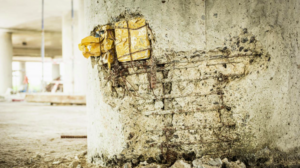
- Concrete spalling and surface deterioration
- Recurring leakage during monsoon rainfall
- Water ingress around service penetrations
- Dampness in lift pits and underground service rooms
Where leakage is accompanied by structural cracking, significant concrete damage, movement or distortion, a qualified structural engineer should assess the affected area.
Water near electrical installations also requires immediate precautions by suitably qualified personnel.
4. What Is Injection Grouting for Basement Waterproofing?
Injection grouting involves introducing a suitable material into cracks, joints, voids or other defined pathways using specialised injection equipment.
The objective may be to control water ingress, seal defects, fill voids or restore structural continuity depending on the material and application.
Common Injection Materials
- Polyurethane (PU) injection resins
- Epoxy injection resins
- Acrylic or acrylate injection gels
- Specialised cementitious injection grouts
Material selection depends on leakage conditions, crack movement, substrate condition, water pressure, accessibility and the intended repair objective.
Key Distinction: PU injection is commonly selected to control water leakage through suitable cracks and joints. Epoxy injection is commonly selected for suitable structural crack bonding. The two materials are not interchangeable for every application.
5. Polyurethane (PU) Injection Grouting
Polyurethane injection grouting is widely used to control groundwater leakage through concrete cracks, joints and selected voids.
Different PU formulations have different characteristics. Some react with moisture and expand, while others form relatively flexible sealing materials.
Typical Applications of PU Injection
- Leaking cracks in basement retaining walls
- Construction joint leakage
- Wall-to-floor junction leakage
- Selected pipe penetration defects
- Water ingress in lift pits and sump areas
- Suitable underground concrete structures
Advantages of PU Injection
- Can be applied from the accessible basement side
- Suitable formulations can react in wet conditions
- Useful for targeted leakage control
- Can reduce the need for extensive excavation
- Available in different viscosity and flexibility grades
Limitations of PU Injection
- Does not automatically restore structural capacity
- Unsuitable products may not accommodate future movement
- Injection paths may be difficult to predict
- Incomplete injection can leave water pathways untreated
- Recurring leakage may require additional investigation
PU injection should be executed with appropriate control of injection pressure, material reaction, packer installation and site conditions.
High-pressure injection without proper control can damage surrounding concrete or force material into unintended locations.
6. Epoxy Injection for Structural Crack Repair
Epoxy injection is generally used to bond suitable dormant cracks in concrete where structural continuity or crack bonding is required.
When properly specified, epoxy resins can penetrate cracks and provide a rigid bond between concrete surfaces.
Typical Epoxy Injection Applications
- Selected dormant structural cracks
- RCC beams and columns requiring crack bonding
- Suitable cracked slabs and walls
- Engineering-specified concrete crack repairs
Important Limitations
- Not generally preferred for actively leaking moving joints
- Many formulations require controlled moisture conditions
- Rigid epoxy may not accommodate continued crack movement
- Repair suitability depends on the cause of cracking
Engineering Requirement: Epoxy injection intended for structural restoration should follow an approved repair specification and the recommendations of a qualified structural engineer.
7. PU Injection vs Epoxy Injection: Comparison
| Parameter | PU Injection | Epoxy Injection |
|---|---|---|
| Main Purpose | Water leakage control | Crack bonding and suitable structural repair |
| Typical Conditions | Wet or actively leaking cracks | Suitable dormant cracks |
| Flexibility | Depends on formulation; flexible grades available | Generally rigid |
| Water Reaction | Some formulations react with moisture | Generally does not use water-reactive expansion |
| Structural Bonding | Not normally used to restore structural continuity | Can provide structural bonding where specified |
| Typical Application | Leaking basement joints and cracks | Engineering-specified dormant crack repairs |
The appropriate injection system must be selected after evaluating crack movement, moisture conditions, leakage flow, structural requirements and product suitability.
8. Step-by-Step PU Injection Grouting Procedure
Injection procedures vary according to product selection, crack geometry and leakage conditions. A typical controlled application involves the following stages.
- Leakage Inspection: Identify visible leakage locations, crack patterns, joints and water-entry pathways. Assess the surrounding concrete.
- Selection of Injection Material: Select an appropriate PU resin based on leakage flow, water pressure, crack movement and manufacturer requirements.
- Marking Injection Locations: Establish drilling positions and spacing according to crack geometry, member thickness and the approved method statement.
- Drilling and Packer Installation: Drill suitable holes and install injection packers, avoiding embedded services, reinforcement and damage to the structure.
- Controlled Injection: Inject the selected resin using appropriate equipment and controlled pressure, observing material movement and leakage response.
- Monitoring and Additional Treatment: Assess whether the injection has adequately treated the intended leakage pathway. Additional injection may be required.
- Packer Removal and Surface Repair: Remove packers at the specified stage, seal drilled holes and restore affected surface finishes.
- Final Inspection: Review the treated areas and document the results under the agreed inspection and testing conditions.
Injection Safety Considerations
- Use injection equipment suited to the selected material
- Follow manufacturer pressure limitations and safety instructions
- Provide suitable PPE and ventilation
- Identify embedded reinforcement and services before drilling
- Prevent uncontrolled resin release and environmental contamination
- Do not inject into structurally unstable concrete without engineering assessment
9. Other Basement Waterproofing and Repair Systems
Injection grouting is only one component of basement leakage repair. Other methods may be necessary depending on the defect and accessibility.
9.1 Positive-Side Waterproofing
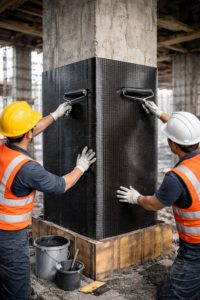
Positive-side waterproofing is applied to the side of the structure exposed to incoming water, normally the external face of a basement wall or beneath a foundation slab.
Common systems include suitable sheet membranes, liquid-applied membranes and other engineered below-ground waterproofing assemblies.
For existing basements, external access may require excavation and appropriate temporary works.
9.2 Negative-Side Waterproofing
Negative-side waterproofing is applied from the accessible internal face of the basement.
Selected cementitious, crystalline or other proprietary systems may be suitable when approved for the expected water pressure and substrate.
These systems require appropriate surface preparation and careful treatment of cracks and joints.
9.3 Acrylic or Acrylate Injection Gels
Specialised low-viscosity acrylic injection gels may be used in selected applications involving joints, cracks or behind-structure waterproofing.
Material selection must consider groundwater conditions, site constraints and environmental requirements.
9.4 Construction Joint Sealing
Defective construction joints may require specialised injection, compatible sealants or other engineered joint repair systems.
Moving joints need systems capable of accommodating the anticipated movement.
9.5 Drainage and Water Management Systems
Where appropriate, external drainage, internal cavity drainage, collection channels or sump pumping systems may help manage groundwater entering or approaching a structure.
Such systems require engineering design, maintenance access and consideration of power failure and overflow risks.
9.6 Concrete Repair and Rehabilitation
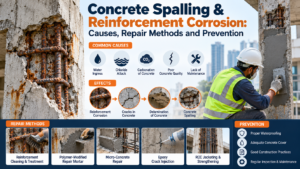
Where leakage has contributed to reinforcement corrosion, spalling or concrete deterioration, an approved concrete repair programme may be necessary alongside waterproofing.
10. Positive-Side vs Negative-Side Basement Waterproofing
| Parameter | Positive-Side | Negative-Side |
|---|---|---|
| Application Side | Water-facing side | Internal accessible side |
| Typical Use | New construction or accessible external walls | Existing basements with restricted external access |
| Main Advantage | Can limit water entry into the structure | Can be installed without full external excavation |
| Main Limitation | External access may be difficult | May leave structural concrete exposed to moisture |
| Important Requirement | Continuity, protection and drainage detailing | Resistance to negative water pressure and bond performance |
Positive-side waterproofing is often desirable because it can prevent water from entering the structural concrete.
However, for existing basements where external excavation is impractical, suitable negative-side treatments or injection systems may be considered.
The selected solution should be based on technical feasibility rather than access alone.
11. Common Reasons Basement Leakage Repairs Fail
Repeated leakage often indicates incomplete diagnosis, unsuitable materials or untreated water-entry pathways.
Common Repair Failures
- Injecting only the visible leakage point
- Using unsuitable resin for the crack or joint
- Inadequate drilling or packer placement
- Uncontrolled injection pressure
- Failure to address joint movement
- Ignoring defective external drainage
- Applying coatings over unsound or contaminated concrete
- Using a rigid material in a moving joint
- Incomplete treatment of multiple leakage pathways
- Failure to verify the repair under relevant conditions
Basement leakage can be influenced by changing groundwater conditions and seasonal rainfall.
A repair that appears successful during dry conditions may require further verification when groundwater pressure increases.
12. Basement Waterproofing for Housing Societies and Commercial Buildings
Basement Parking Areas
Underground parking levels frequently experience leakage through retaining walls, construction joints and raft junctions.
Repair planning should consider vehicle access, electrical installations, drainage, ventilation and occupant safety.
Housing Society Basements
Housing societies may encounter recurring water seepage in parking levels, lift pits, pump rooms and underground utility areas.
A systematic leakage survey and itemised repair programme can help the managing committee evaluate treatment options.
Commercial Buildings and Malls
Commercial basements may contain parking, storage, building services and mechanical equipment.
Waterproofing works must be coordinated with operational requirements and safe access arrangements.
Industrial Buildings
Industrial underground structures may include equipment pits, pump rooms, cable trenches, sumps and utility chambers.
Leakage repairs require consideration of equipment protection, environmental exposure and operational restrictions.
13. How Much Does Basement Waterproofing Cost?
Basement waterproofing costs in Mumbai and Thane vary substantially depending on the extent of leakage, selected repair system, accessibility and site conditions.
Major Cost Factors
- Number and extent of leaking cracks or joints
- Severity and flow rate of water leakage
- Groundwater pressure conditions
- Type and quantity of injection resin
- Injection drilling and packer requirements
- Concrete repair and substrate preparation
- Requirement for external excavation
- Waterproofing coating or membrane specification
- Access and operational restrictions
- Testing, supervision and quality control
Typical Basement Waterproofing BOQ Items
| Work Item | Typical Unit |
|---|---|
| Leakage mapping and inspection | Item |
| PU injection grouting | Running metre, point or item |
| Epoxy crack injection | Running metre or item |
| Injection port installation | Number, where separately measured |
| Construction joint sealing | Running metre |
| Cementitious waterproofing | m² |
| External waterproofing membrane | m² |
| Concrete patch restoration | m² or m³ |
| Drainage improvement works | Running metre or item |
| Access and temporary works | Item or lump sum |
Quotation Recommendation: Injection grouting quotations should clearly specify the resin type, measurement basis, treatment extent, estimated consumption, exclusions and agreed performance verification procedure.
Resin consumption can be difficult to estimate precisely where hidden voids and interconnected leakage pathways are present.
The contract should therefore define how variations and additional treatment requirements will be handled.
14. How to Prevent Recurring Basement Leakage
Long-term leakage management requires attention to waterproofing, drainage and structural condition.
Recommended Preventive Measures
- Maintain functioning external and internal drainage systems
- Inspect accessible basement walls and construction joints
- Investigate recurring damp patches before they worsen
- Maintain sumps and pumps where installed
- Protect waterproofing during future drilling or modifications
- Seal new service penetrations using appropriate details
- Maintain records of injection and previous repairs
- Inspect repaired areas during significant rainfall
- Address concrete spalling and corrosion promptly
No waterproofing intervention should be regarded as permanently maintenance-free. Long-term performance depends on the repair method, groundwater conditions, material suitability and subsequent maintenance.
15. Choosing a Basement Waterproofing Contractor
Basement leakage repair requires more than routine coating application.
The contractor should understand injection techniques, waterproofing systems, concrete deterioration and the importance of identifying leakage mechanisms.
Key Contractor Evaluation Criteria
- Experience with basement leakage repair
- Knowledge of PU and epoxy injection systems
- Ability to identify cracks, joints and leakage pathways
- Suitable injection equipment and trained applicators
- Understanding of material compatibility
- Appropriate work methodology and safety arrangements
- Quality control and completion documentation
- Transparent itemised quotations
- Clearly defined warranty and defect liability terms
The selected contractor should provide a technically justified solution rather than recommending the same injection resin for every leakage problem.
16. How Structonix Approaches Basement Leakage Repair
Structonix provides specialised waterproofing, injection grouting, concrete repair and rehabilitation execution services for residential, commercial and industrial structures.
Our approach focuses on understanding visible leakage, reviewing the existing concrete condition and implementing suitable treatment methodologies according to site requirements and approved specifications.
Our Basement Waterproofing Services
- PU injection grouting for water leakage
- Epoxy injection for specified concrete crack repairs
- Construction joint leakage treatment
- Basement wall and raft junction repairs
- Negative-side waterproofing systems
- External waterproofing where accessible
- Concrete spalling and reinforcement corrosion repairs
- Waterproofing around service penetrations
- Associated concrete restoration and protection works
Where structural damage, foundation movement or significant deterioration is suspected, treatment should be coordinated with an assessment by a qualified structural engineer.
We consider suitable basement waterproofing and rehabilitation projects across Mumbai, Thane, Navi Mumbai and surrounding areas of Maharashtra.
17. Frequently Asked Questions
What is the main cause of basement water leakage?
Basement leakage may result from groundwater pressure, concrete cracks, defective construction joints, inadequate waterproofing, pipe penetrations or drainage problems. The cause must be identified through appropriate site investigation.
Is PU injection effective for basement leakage?
Suitable PU injection systems can effectively control water leakage through selected cracks and joints. Performance depends on the defect, resin selection, injection methodology and site conditions.
What is the difference between PU and epoxy injection?
PU injection is commonly used for water leakage control. Epoxy injection is generally used for suitable dormant cracks requiring structural bonding. Material selection depends on the repair objective.
Can basement leakage be repaired from the inside?
Yes. Some leakage problems can be treated using internal injection, negative-side waterproofing or suitable drainage systems. The method depends on water pressure, substrate condition and defect characteristics.
Is excavation necessary for basement waterproofing?
Not always. External excavation may be necessary for some positive-side repairs, while selected injection and internal waterproofing treatments may be carried out without external excavation.
How long does PU injection grouting last?
Durability depends on the resin, crack movement, chemical exposure, groundwater conditions and installation quality. No universal service life can be guaranteed.
Can injection grouting repair structural cracks?
Some epoxy injection systems can be used for suitable structural crack bonding. PU injection used for leakage control should not be assumed to restore structural capacity.
Can basement waterproofing stop seepage permanently?
Properly designed and executed systems can provide durable leakage control. However, performance depends on the underlying cause, groundwater conditions, building movement and maintenance.
Does Structonix provide basement waterproofing in Mumbai and Thane?
Structonix provides specialised waterproofing, injection grouting and concrete repair execution services for suitable projects in Mumbai, Thane, Navi Mumbai and nearby service areas.
18. Conclusion: Choosing the Right Basement Leakage Solution
Basement waterproofing requires a systematic understanding of groundwater conditions, concrete defects, construction joints and the existing waterproofing system.
PU injection, epoxy injection, external membranes, negative-side treatments and drainage systems each have specific applications and limitations.
The appropriate solution depends on the actual source of leakage, accessibility, structural condition and technical requirements.
For housing societies, commercial property managers and industrial facility owners, early investigation and technically appropriate repairs can help reduce recurring seepage, protect building materials and maintain basement serviceability.