Industrial Building Structural Repairs: A Guide for Factory Owners & Facility Managers
Industrial buildings are exposed to demanding operating conditions, including heavy machinery, vibration, equipment loading, moisture, chemical exposure and continuous production activities. Over time, these conditions can contribute to deterioration of reinforced concrete, structural steel, industrial floors and other critical building components.
For factory owners, plant heads and facility managers, structural deterioration is more than a building maintenance concern. It can affect worker safety, equipment reliability, operational continuity and future expansion plans.
Effective industrial structural repairs require an organised approach involving condition assessment, engineering review, appropriate repair methods and execution planning that considers factory operations.
Manufacturing facilities across Mumbai, Thane, Navi Mumbai and surrounding MIDC industrial areas frequently require maintenance and rehabilitation of existing RCC and structural steel elements.
This guide explains common structural problems in industrial buildings, suitable repair and strengthening methods, shutdown planning, cost considerations and how to select a competent structural repair contractor.
1. What Are Industrial Building Structural Repairs?
Industrial structural repairs involve restoring damaged or deteriorated building components to meet their required structural and serviceability performance.
These repairs may involve reinforced cement concrete (RCC), structural steel, equipment foundations, industrial floor slabs and associated building elements.
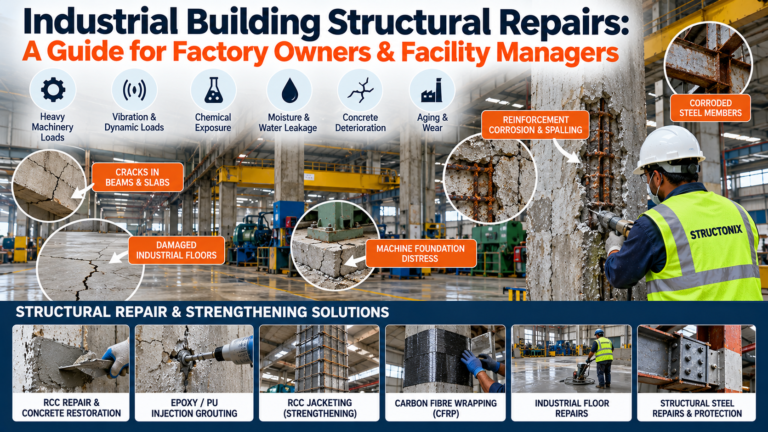
Typical Industrial Structural Repair Works
- RCC column and beam repairs
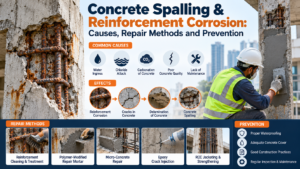
- Concrete spalling and section restoration
- Reinforcement corrosion treatment
- Crack repair and injection grouting
- Industrial RCC floor slab repairs
- Machine foundation and pedestal repairs
- Structural steel member rehabilitation
- RCC jacketing and structural strengthening
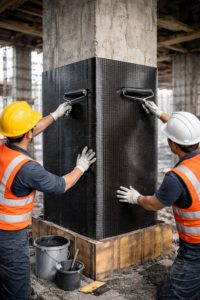
- CFRP wrapping and strengthening systems
- RCC tank, pit and bund wall repairs
- Waterproofing and concrete protection systems
Important: Structural repairs are different from ordinary painting, plastering or cosmetic maintenance. Where load-bearing members are affected, the repair scope should be established through appropriate engineering assessment and specifications.
2. Why Do Industrial Buildings Deteriorate?
Industrial buildings may experience deterioration due to a combination of environmental exposure, operational loading and maintenance conditions.
2.1 Reinforcement Corrosion
Moisture, carbonation and chloride contamination can contribute to corrosion of embedded reinforcement.
Corrosion products may cause cracking, delamination and concrete spalling, while significant steel section loss can affect structural performance.
2.2 Machinery Vibration and Dynamic Loading
Industrial machinery may transmit dynamic loads and vibration to equipment foundations, floor slabs and adjacent structural members.
Where vibration levels, foundation design or equipment conditions are unsuitable, cracking, movement or localised distress may develop.
2.3 Heavy Equipment and Storage Loads
Factory buildings may accommodate heavy machinery, storage racks, forklifts, overhead cranes and production equipment.
Changes in loading or use beyond the original design assumptions may require structural evaluation or strengthening.
2.4 Chemical Exposure
Certain industrial environments expose concrete and steel to acids, alkalis, salts, process chemicals and aggressive liquids.
Chemical resistance depends on the substances involved, their concentration, temperature, exposure duration and the selected protective systems.
2.5 Water Leakage and Moisture
Roof leakage, plumbing failures, process water and poor drainage can expose concrete and steel to prolonged moisture.
Continued water ingress may accelerate corrosion and deterioration.
2.6 Ageing and Construction Defects
Inadequate concrete cover, honeycombing, poor curing, defective construction joints and original workmanship issues may contribute to premature deterioration.
2.7 Unauthorised Structural Modifications
Openings in slabs, removal of supports, changes to steel framing or installation of new equipment without proper engineering review can alter structural load paths.
3. Warning Signs of Structural Damage in Factories
Facility managers should regularly observe accessible structural components for deterioration and report concerns for professional review.
Important Structural Distress Indicators
- Cracks in RCC columns, beams or slabs
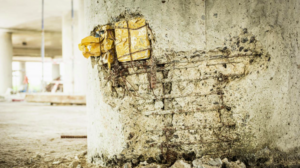
- Concrete spalling and exposed reinforcement
- Rust staining and corroded steel members
- Cracking around machine foundations
- Floor settlement or uneven industrial floors
- Unusual deflection of structural members
- Loose or damaged structural connections
- Recurring cracks after previous repairs
- Water leakage affecting load-bearing elements
- Damage around crane supports or equipment pedestals
These signs require appropriate evaluation and should not be interpreted as proof of structural failure without investigation.
Where sudden movement, falling concrete, serious connection damage or potential instability is observed, affected operations should be stopped and the area isolated pending urgent professional assessment.
4. Common Structural Repair Requirements in Industrial Buildings
4.1 RCC Column and Beam Repairs
Factory RCC columns and beams may experience corrosion-related spalling, cracking, impact damage or deterioration from environmental exposure.
Repairs may include removal of unsound concrete, reinforcement treatment and restoration using compatible repair materials.
4.2 Industrial Floor Slab Repairs
Industrial floor slabs may develop cracks, joint deterioration, surface damage, settlement or defects affecting equipment and forklift movement.
Repair methods vary according to whether the problem affects the wearing surface, slab joints, subgrade support or structural capacity.
4.3 Machine Foundation Repairs
Machine foundations may require repairs to cracked pedestals, damaged grout beds, anchor bolt zones or distressed concrete.
The machinery supplier, maintenance team and structural engineer should coordinate the repair methodology, especially where dynamic loading or alignment is involved.
4.4 Structural Steel Repairs
Steel frames, support platforms and connections may be affected by corrosion, accidental damage, fatigue or unsuitable modifications.
Remedial work may include specified member replacement, connection repair, strengthening or protective coatings.
4.5 RCC Tanks, Pits and Bund Repairs
Industrial water tanks, utility pits, trenches and containment bunds may require crack repairs, concrete restoration or compatible chemical protection systems.
Repair methods must consider the stored substances, exposure, watertightness and operating conditions.
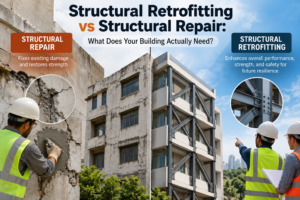
4.6 Structural Strengthening and Retrofitting
Where additional loading or structural deficiencies are identified, engineered strengthening may be necessary.
Techniques may include RCC jacketing, steel strengthening, CFRP systems or other approved structural modifications.
5. Industrial Structural Repair Methods
The repair system should be selected based on the deterioration mechanism, structural requirements and approved specifications.
| Repair Method | Typical Application | Key Consideration |
|---|---|---|
| Polymer-modified repair mortar | Localised RCC section repairs | Thickness, bonding and curing |
| Micro-concrete | Larger concrete restoration works | Formwork, placement and shrinkage |
| Epoxy crack injection | Suitable dormant concrete cracks | Structural requirements and crack movement |
| PU injection grouting | Leakage through suitable cracks and joints | Water pressure and resin compatibility |
| RCC jacketing | Strengthening beams and columns | Engineered detailing and load transfer |
| CFRP strengthening | Selected member strengthening | Substrate quality and anchorage |
| Steel member repair | Damaged frames and connections | Design, fabrication and corrosion protection |
| Protective coatings | Concrete and steel protection | Exposure and chemical compatibility |
A qualified structural engineer should determine whether a structural member requires restoration, strengthening or replacement.
6. Industrial Structural Repair Process: Step by Step
A structured process helps factory owners define the repair scope, evaluate quotations and coordinate works with plant operations.
- Initial Site Inspection: Identify visible defects, affected members, operating constraints and potential hazards.
- Engineering Assessment: Review available structural drawings, loading, previous repairs and relevant testing or assessment reports.
- Repair Scope Development: Establish necessary concrete repairs, strengthening, waterproofing or steel rehabilitation.
- BOQ and Method Statement: Prepare suitable specifications, estimated quantities, execution sequence and quality requirements.
- Factory Coordination: Agree work zones, production restrictions, equipment protection, shutdown requirements and access.
- Mobilisation and Safety: Arrange applicable permits, barricading, safe access, equipment isolation and temporary support where specified.
- Surface Preparation: Remove defective materials and prepare the substrate according to approved specifications.
- Repair and Strengthening: Execute approved restoration or strengthening using suitable materials and trained personnel.
- Testing and Quality Control: Carry out inspections, material checks, measurements and specified testing.
- Handover and Return to Service: Complete rectification, documentation and necessary engineering acceptance before the affected area is returned to use.
7. Structural Repairs During Factory Operations
Industrial repair projects are frequently complicated by ongoing manufacturing activities, limited access and the need to protect operating equipment.
Important Planning Considerations
- Define repair zones and production interfaces
- Identify equipment, services and utilities
- Plan controlled access routes for personnel and materials
- Provide suitable dust and debris containment
- Control noise and vibration from repair activities
- Protect machinery and finished products
- Coordinate temporary electrical and mechanical isolation
- Plan safe access and material handling
- Arrange required permits and supervision
- Coordinate curing and return-to-service conditions
Operational Planning: A repair programme may be divided into multiple work zones or phases to reduce interference with factory operations, provided that the structural engineer and plant safety team approve the sequence.
Safety and structural stability must not be compromised to maintain production.
8. Factory Shutdown Structural Repair Works
Planned factory shutdowns provide an opportunity to undertake repairs in locations that are difficult to access during regular operations.
Typical Shutdown Repair Activities
- Repairs below fixed machinery and equipment
- Structural steel repairs in operational bays
- RCC restoration around production equipment
- Machine foundation rehabilitation
- Industrial floor joint repairs
- Repairs to pits and containment structures
- Specified strengthening and anchoring works
Shutdown Planning Checklist
| Activity | Planning Requirement |
|---|---|
| Pre-shutdown inspection | Finalise defects, access and work quantities |
| Engineering approval | Approve repair details and temporary works |
| Material procurement | Arrange approved products and equipment |
| Plant isolation | Coordinate with maintenance and EHS teams |
| Execution programme | Define daily work fronts and hold points |
| Curing and testing | Allow for material performance requirements |
| Return to service | Obtain necessary checks and authorisations |
Repair products should not be selected only because they advertise rapid strength development.
Their suitability must be verified for the actual repair, loading and required return-to-service performance.
9. Safety Requirements for Industrial Structural Repairs
Structural rehabilitation inside operational factories requires coordination with the facility's Environment, Health and Safety (EHS) procedures.
Important Safety Controls
- Task-specific risk assessment and method statement
- Permit-to-work procedures where required
- Lockout and isolation of affected equipment
- Safe access and fall protection
- Scaffolding and elevated work controls
- Dust and silica exposure controls
- Hot-work controls for cutting and welding
- Confined-space controls where applicable
- Protection against falling debris
- Assessment of temporary structural stability
- Emergency access and response arrangements
Industrial structures must not be modified, cut, drilled or partially demolished without assessing the effects on the structural system.
Temporary propping, load restrictions and construction sequencing should be established by qualified professionals where required.
10. Industrial Floor Repairs vs Structural Floor Strengthening
Not all industrial floor defects require structural strengthening.
Surface wear, minor joint damage and localised deterioration may be repairable without altering slab capacity.
However, settlement, inadequate load capacity, severe cracking or subgrade failure may require more extensive investigation.
| Floor Problem | Possible Intervention |
|---|---|
| Surface wear and abrasion | Surface restoration or specified topping |
| Damaged construction joints | Joint edge repair and appropriate joint treatment |
| Dormant concrete cracks | Compatible crack repair where suitable |
| Slab settlement | Subgrade and structural investigation |
| Inadequate machinery load capacity | Engineered strengthening or reconstruction |
| Severe slab deterioration | Detailed evaluation and possible replacement |
Floor repairs should consider forklift traffic, storage loads, flatness requirements and operational tolerances.
11. When Is Structural Strengthening Required in a Factory?
Structural strengthening may be necessary where the existing building cannot meet the required loading or performance criteria.
Examples of Strengthening Requirements
- Installation of additional heavy equipment
- Increase in storage rack loading
- Modification of crane support systems
- Structural deficiencies identified by an engineer
- Changes in building use or internal layout
- Significant deterioration of load-bearing elements
- Modification of existing structural frames
Depending on the engineering assessment, selected strengthening methods may include RCC jacketing, CFRP wrapping, steel plate bonding or new structural components.
Strengthening design must address the complete load path, including connections and foundations.
12. Industrial Structural Repair Cost Factors
The cost of industrial structural repairs varies depending on damage severity, repair specifications, accessibility and production constraints.
Major Cost Factors
- Extent of damaged concrete or steel
- Repair depth and quantities
- Structural strengthening requirements
- Selected materials and application systems
- Specialised access and temporary works
- Equipment protection and isolation
- Shutdown or restricted working periods
- Testing and quality control requirements
- Safety and environmental protection measures
- Mobilisation and working location
Typical Industrial Structural Repair BOQ
| Work Item | Typical Unit |
|---|---|
| Damaged concrete removal | m² or m³ |
| Reinforcement cleaning and treatment | m², running metre or item |
| Polymer-modified mortar repairs | m² by thickness or m³ |
| Micro-concrete repairs | m³ |
| Epoxy / PU injection | Running metre or item |
| Structural steel repair and strengthening | kg or item |
| RCC jacketing | Itemised concrete, steel and formwork |
| CFRP strengthening | m² or running metre |
| Industrial floor slab repairs | m² or m³ |
| Protective coatings | m² |
| Scaffolding and access | m², duration or lump sum |
| Testing and inspections | Item or specified test |
Cost Planning Recommendation: Factory owners should request detailed BOQ-based quotations, including assumptions, material specifications, shutdown requirements, exclusions and measurement procedures.
Project cost comparisons should also account for operational disruption, not just the direct repair contract value.
13. Preventive Structural Maintenance for Factories
A planned maintenance programme can help identify deterioration before repairs become more extensive.
Recommended Maintenance Practices
- Maintain a register of major structural components
- Record recurring cracks and deterioration
- Inspect exposed RCC and steel components
- Maintain roof and drainage systems
- Control process water and chemical leakage
- Review equipment loading before modifications
- Check industrial floor joints and damage
- Maintain suitable corrosion protection systems
- Arrange periodic professional structural assessments
- Maintain repair records and engineering drawings
Inspection frequency should be determined according to building condition, exposure, operational risks and applicable regulatory requirements.
14. How to Choose an Industrial Structural Repair Contractor
Industrial structural rehabilitation requires contractors who understand both engineering specifications and the constraints of operating facilities.
Important Contractor Selection Criteria
- Relevant industrial repair project experience
- Technical understanding of RCC and steel repairs
- Ability to execute approved structural designs
- Experience working in operational factories
- Capability for shutdown and phased execution
- Appropriate EHS and permit-to-work procedures
- Qualified site supervision and skilled personnel
- Material documentation and quality control
- Transparent BOQ pricing and variation procedures
- Defined completion and defect liability obligations
The lowest quotation should not be the only selection criterion for structural repair works affecting critical factory infrastructure.
15. How Structonix Supports Industrial Structural Repair Projects
Structonix provides specialised structural repair, rehabilitation, strengthening and waterproofing execution services for existing industrial buildings and facilities.
Our approach combines practical construction knowledge with project-specific repair methodologies, careful substrate preparation, suitable materials and quality-controlled execution.
Our Industrial Repair Services
- RCC column, beam and slab repairs
- Concrete spalling and reinforcement corrosion treatment
- Industrial floor and joint repairs
- Machine foundation and pedestal rehabilitation
- RCC jacketing and structural strengthening
- CFRP wrapping and steel strengthening
- Concrete crack injection and grouting
- RCC tank, pit and bund repairs
- Industrial waterproofing and leakage rectification
- Concrete protection and compatible coatings
- Planned industrial shutdown civil repair works
Where structural analysis, stability assessment, strengthening design or certification is necessary, execution should follow the recommendations and approved documents of a qualified structural engineer.
We consider suitable industrial structural repair projects across Mumbai, Thane, Navi Mumbai, Rabale, Mahape, Taloja, Ambernath, Badlapur and surrounding MIDC industrial areas.
16. Frequently Asked Questions
What are the most common structural problems in industrial buildings?
Common problems include RCC cracking, concrete spalling, reinforcement corrosion, damaged industrial floors, machine foundation distress and deterioration of structural steel elements.
Can structural repairs be carried out while a factory is operational?
Some repairs can be executed in controlled work zones while other areas remain operational. The decision depends on structural safety, equipment isolation, access and the approved work methodology.
Is a shutdown necessary for RCC repairs?
Not always. Certain localised repairs may be executed without a complete shutdown. However, repairs affecting critical structural members or operational equipment may require temporary isolation or shutdown.
Can damaged machine foundations be repaired?
Many machine foundation defects can be repaired or rehabilitated. The appropriate method depends on the damage, foundation performance, equipment loading and engineering assessment.
Does every cracked industrial floor require replacement?
No. Some floor defects can be addressed using appropriate crack, joint or surface repairs. Severe settlement, inadequate support or structural deficiencies may require more extensive intervention.
When is RCC jacketing required in a factory?
RCC jacketing may be specified when an existing structural member requires additional capacity or improved performance. The need must be established through structural assessment and design.
What affects the cost of industrial structural repairs?
Repair cost depends on the affected members, damage extent, selected repair materials, access arrangements, shutdown requirements, testing and project conditions.
How can a facility manager prevent recurring structural damage?
Preventive measures include planned inspections, water leakage control, suitable corrosion protection, monitoring of structural defects and professional review before major equipment or loading changes.
Does Structonix undertake industrial structural repairs in MIDC areas?
Structonix considers suitable industrial structural repair and rehabilitation projects across Mumbai, Thane, Navi Mumbai and surrounding MIDC industrial locations, subject to project scope and requirements.
17. Conclusion: Planning Reliable Industrial Structural Repairs
Industrial structural repairs should be planned as part of a systematic facility maintenance and risk management programme.
Concrete deterioration, reinforcement corrosion, machinery-related distress, damaged steel members and floor defects require appropriate investigation and technically justified repair methods.
For factory owners and facility managers, successful projects depend on clearly defined repair scopes, qualified engineering input, safe execution, effective plant coordination and documented quality control.
Early identification of deterioration and planned rehabilitation can help maintain structural serviceability, manage repair costs and reduce avoidable disruption to industrial operations.