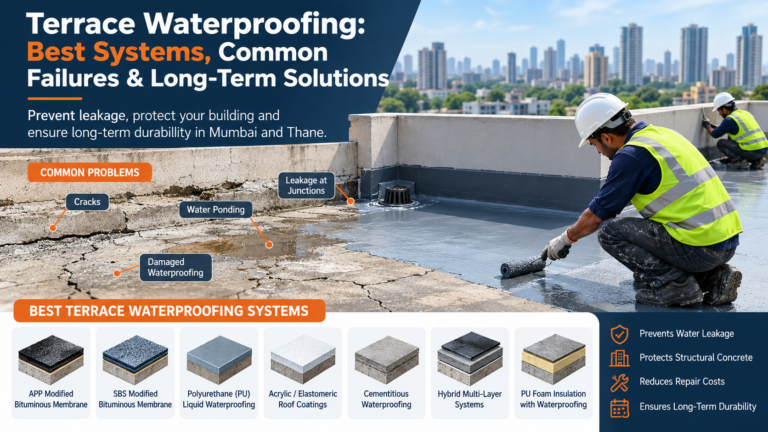
Terrace Waterproofing: Best Systems, Common Failures & Long-Term Solutions
Terrace waterproofing plays an essential role in protecting residential, commercial and industrial buildings from water leakage, moisture-related deterioration and damage to reinforced concrete roof slabs.
In Mumbai, Thane and Navi Mumbai, heavy monsoon rainfall, high humidity and repeated temperature changes can expose weaknesses in existing waterproofing systems.
Terrace leakage is frequently associated with deteriorated waterproofing membranes, inadequate drainage, cracks in roof surfaces, poorly treated junctions and ineffective earlier repairs.
However, successful waterproofing requires more than applying a chemical coating over an existing terrace. The underlying leakage source, condition of the substrate, drainage arrangements and intended terrace usage must be evaluated.
This guide explains the best terrace waterproofing systems, common causes of waterproofing failure, repair methods, installation procedures and long-term solutions for existing and new buildings.
1. Why Is Terrace Waterproofing Important?
Terraces and roof slabs are exposed directly to rainfall, sunlight, temperature variations and environmental conditions.
If waterproofing fails, water may penetrate through cracks, construction joints, defective interfaces or deteriorated materials.
Common Consequences of Terrace Leakage
- Water stains and dampness on ceilings
- Peeling paint and damaged interior finishes
- Moisture accumulation within roof assemblies
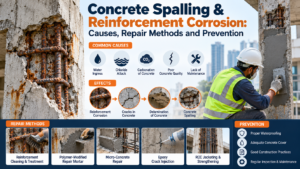
- Corrosion of embedded steel reinforcement
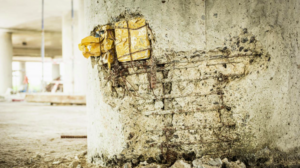
- Concrete cracking and spalling
- Damage to electrical fittings and services
- Fungal growth and indoor moisture problems
- Repeated maintenance and repair expenditure
Waterproofing therefore contributes to the long-term durability and serviceability of the building, particularly where reinforced concrete roof slabs are exposed to persistent moisture.
Important: Waterproofing is primarily intended to prevent water ingress. It does not restore the structural capacity of damaged concrete. Where corrosion, concrete spalling or structural cracking is identified, an appropriate engineering assessment and repair programme may also be required.
2. Common Causes of Terrace Water Leakage
2.1 Cracks in the Roof Slab or Screed
Cracks can develop due to shrinkage, thermal movement, restraint, structural movement or deterioration. Water may enter through cracks where the waterproofing system is missing or no longer effective.
2.2 Failure of Existing Waterproofing
Existing membranes and coatings may deteriorate due to ageing, ultraviolet exposure, movement, moisture-related blistering, mechanical damage or installation defects.
2.3 Inadequate Drainage Slope
Terraces with inadequate falls towards drainage outlets may experience standing water after rainfall.
Prolonged ponding increases exposure at joints, penetrations and weak locations and can adversely affect systems not designed for continuous water immersion.
2.4 Defective Parapet Junctions
The junction between a horizontal roof slab and a vertical parapet is an important waterproofing detail.
Differential movement, inadequate membrane upstands or poorly executed corner treatment can allow water to enter behind the waterproofing layer.
2.5 Leakage Around Drain Outlets
Roof outlets are vulnerable locations because multiple materials and surfaces meet around the drainage opening.
Poor bonding, defective flashing, damaged collars or inadequate integration with the membrane may lead to water ingress.
2.6 Pipe Penetrations and Equipment Supports
Plumbing pipes, solar equipment, air-conditioning supports, railings and other installations may penetrate or interrupt the waterproofing system.
Unsealed penetrations and poorly detailed fixings can create leakage pathways.
2.7 Incompatible Repair Materials
Applying a new waterproofing product over an old treatment without verifying compatibility and adhesion can result in premature failure.
The existing surface may require removal, preparation or specialised treatment before a new system is installed.
3. Best Terrace Waterproofing Systems
There is no single waterproofing product suitable for every terrace.
System selection should consider roof condition, drainage, anticipated movement, exposure, foot traffic, protective finishes and compatibility with the substrate.
3.1 APP Modified Bituminous Membrane
Atactic Polypropylene (APP) modified bituminous membranes are prefabricated waterproofing sheets commonly installed using an approved torch-applied method.
Suitable membrane configurations may be used for exposed or protected roof applications, depending on the product specification and system design.
Typical Applications:
- RCC terraces and flat roofs
- Protected waterproofing systems
- Commercial and industrial roof areas
- Suitable roof rehabilitation projects
Installation requires proper substrate preparation, primer, lap treatment, upstand detailing and termination protection.
Torch application must be carried out under suitable fire-safety controls and should not be used where site conditions make hot works unsafe.
3.2 SBS Modified Bituminous Membrane
Styrene-Butadiene-Styrene (SBS) modified bituminous membranes provide flexibility and can accommodate appropriate levels of movement within their specified operating conditions.
Installation methods vary depending on the product and may include approved torch-applied, self-adhesive or other specified systems.
Typical Applications:
- Roof areas requiring flexible membrane systems
- Protected waterproofing assemblies
- Suitable existing roof rehabilitation projects
- Selected applications involving thermal movement
The membrane grade and installation method should be matched to the roof exposure and specifications.
3.3 Polyurethane (PU) Liquid Waterproofing
Polyurethane waterproofing systems form a continuous liquid-applied membrane after curing.
Depending on the approved product and system build-up, PU coatings may be suitable for roofs with multiple penetrations, complex geometry or detailed junctions.
Typical Applications:
- RCC terraces and balconies
- Complex roof configurations
- Roofs with multiple service penetrations
- Suitable protected or exposed roof systems
Substrate moisture limitations, primer compatibility, application thickness, curing and UV protection requirements must be checked.
Not all PU membranes are suitable for permanent exposure or persistent ponding water.
3.4 Acrylic and Elastomeric Roof Coatings
Acrylic and elastomeric waterproofing coatings form a flexible protective layer over suitable prepared surfaces.
Certain products offer reflective finishes that can help reduce roof surface heat absorption.
Typical Applications:
- Suitable exposed concrete terraces
- Roof coating renewal works
- Selected maintenance applications
- Roofs with appropriate drainage
These systems must be evaluated for crack movement, water exposure, required thickness and compatibility with existing coatings.
They should not be treated as a universal substitute for robust sheet membrane or protected waterproofing systems.
3.5 Cementitious and Polymer-Modified Waterproofing
Cementitious waterproofing systems consist of specially formulated cement-based materials applied to compatible mineral substrates.
Flexible polymer-modified products may provide improved crack-bridging performance compared with rigid formulations, subject to product limitations.
Typical Applications:
- Selected protected terrace assemblies
- Concrete substrates beneath approved finishes
- Balconies and wet areas
- Compatible roof repair details
Many cementitious products require protection from direct long-term weather exposure. Their suitability depends on the complete specified system.
3.6 Hybrid Multi-Layer Waterproofing Systems
Hybrid waterproofing systems combine compatible materials and protection layers to address multiple roof performance requirements.
An engineered system may include primer, compatible waterproofing layers, junction reinforcement, protection and drainage components.
Material compatibility and manufacturer approval are essential when combining different technologies.
3.7 PU Foam Insulation with Waterproofing
Integrated roof systems can combine thermal insulation with a suitable waterproofing membrane and protective finish.
Where specified, polyurethane foam insulation may be incorporated in thicknesses selected according to the required thermal performance and roof assembly design.
The insulation type, waterproofing compatibility, fire performance, drainage, UV protection and maintenance requirements must be considered.
Typical Applications:
- Roofs requiring thermal insulation upgrades
- Commercial and industrial terraces
- Selected exposed RCC roofs
- Integrated energy-efficiency roof renovations
4. Terrace Waterproofing Systems: Comparison Table
| Waterproofing System | Typical Advantage | Key Consideration |
|---|---|---|
| APP Membrane | Robust prefabricated membrane system | Lap quality, detailing and hot-work safety |
| SBS Membrane | Flexible modified bitumen system | Correct grade, installation and protection |
| PU Liquid Membrane | Seamless application around complex details | Moisture, thickness, curing and UV exposure |
| Acrylic / Elastomeric | Liquid-applied coating with selected reflective options | Ponding limitations and maintenance |
| Cementitious Coating | Compatible application on prepared cementitious surfaces | Crack movement and exposure limitations |
| Hybrid System | Combines compatible performance layers | System design and material compatibility |
| Insulated Roof System | Combines waterproofing and thermal performance | Roof build-up, insulation and protective detailing |
The final system should be selected after reviewing the actual terrace condition, drainage, usage, environmental exposure and technical specifications.
5. Why Do Terrace Waterproofing Systems Fail?
Even high-quality waterproofing materials can fail prematurely if the system is incorrectly designed, installed or maintained.
Common Waterproofing Failures
- Insufficient cleaning and substrate preparation.
- Application over unsuitable or excessively damp surfaces.
- Incorrect membrane overlaps and poorly sealed laps.
- Inadequate coating thickness or incomplete application.
- Weak detailing at parapets, outlets and pipe penetrations.
- Inadequate roof slope and persistent water ponding.
- Damage caused by foot traffic, equipment or later construction work.
- Use of incompatible materials over existing treatments.
- Failure to complete required curing and inspection procedures.
- Lack of periodic maintenance.
Can Waterproofing Be Applied Over Existing Tiles?
Certain proprietary systems may be suitable for application over existing tiled surfaces after appropriate preparation and compatibility checks.
However, where tiles are loose, the bedding is damaged, the underlying waterproofing has failed or water is trapped within the roof assembly, surface coating alone may not provide a reliable solution.
In such cases, removal of existing finishes and reconstruction of the waterproofing assembly may be necessary.
6. Importance of Terrace Drainage and Slope
Proper drainage is a fundamental requirement for reliable terrace waterproofing.
Roof surfaces should direct rainwater towards functioning outlets without creating avoidable low points.
Important Drainage Considerations
- Suitable roof falls towards outlets
- Appropriate outlet number and capacity
- Correct drain and membrane interface detailing
- Free-flowing drainage pipes
- Protection against blockage by debris
- Proper treatment of low points and ponding areas
- Safe arrangements for overflow where required
Terrace slopes are commonly designed around suitable falls such as 1:100 or steeper, depending on the roof configuration, finish and applicable design requirements.
The actual slope must be established by the project designer and coordinated with drainage outlets, finished levels and structural constraints.
Important: Waterproofing should not be expected to compensate for defective drainage. Persistent water accumulation may require slope correction, drainage modification or a system specifically approved for the expected water exposure.
7. Complete Terrace Waterproofing Application Process
The application sequence varies by system, but a professionally planned waterproofing project generally follows these steps.
- Site Inspection and Leakage Assessment: Review visible leakage, existing treatments, drainage outlets, substrate condition and likely water-entry paths.
- Selection of Waterproofing System: Select an appropriate membrane or coating based on roof condition, exposure, movement, usage and specifications.
- Removal of Unsound Materials: Remove loose coatings, damaged screeds, unsuitable finishes and defective materials as required by the approved scope.
- Surface Preparation and Repairs: Clean the substrate, repair suitable cracks and surface defects, and prepare the roof for system installation.
- Slope and Drainage Correction: Correct inadequate falls or drainage deficiencies where specified and feasible.
- Junction and Penetration Detailing: Treat parapet junctions, pipe penetrations, construction joints, upstands and outlets using approved details.
- Primer and Waterproofing Application: Apply compatible primers and waterproofing layers in accordance with manufacturer instructions.
- Inspection and Testing: Check membrane continuity, thickness where applicable, overlaps, terminations and agreed test requirements.
- Protective Layer Installation: Install specified protection, screed, tiles or approved exposed finishes without damaging the membrane.
- Final Inspection and Handover: Complete inspections, rectify defects and provide applicable product, testing and maintenance documentation.
8. Waterproofing Testing and Quality Control
Testing helps identify defects before the waterproofing system is covered or handed over.
Common Quality Control Checks
- Substrate preparation and moisture checks
- Primer compatibility and application
- Membrane lap and termination inspections
- Liquid membrane thickness checks
- Details around outlets and penetrations
- Product curing and protection requirements
- Agreed water-retention or other leakage testing
Is a Ponding Test Necessary?
Where technically appropriate, an agreed controlled water-retention or flood test may be conducted after the waterproofing has sufficiently cured.
However, testing must account for the structural capacity of the roof, temporary water loads, weather, overflow provisions and the membrane manufacturer's requirements.
Flood testing should not be carried out without confirming that the roof can safely support the proposed water load.
Some roof systems may require alternative inspection or testing methods.
9. Terrace Waterproofing for Existing Buildings
Existing building terraces often present additional challenges because their roof assemblies may contain several generations of previous waterproofing repairs.
Old brickbat coba, protective screeds, bituminous membranes, cementitious coatings and tiled finishes may conceal the original source of leakage.
Recommended Approach
- Identify the leakage pattern and likely source
- Review the condition of previous treatments
- Assess the roof slab and any visible concrete damage
- Verify the roof slope and drainage arrangement
- Determine whether repairs or system replacement are suitable
- Select compatible waterproofing and protective layers
- Execute approved installation and testing procedures
Where the original waterproofing has deteriorated extensively, replacing the system may offer a more reliable approach than repeated isolated patch repairs.
The decision depends on the existing assembly, extent of damage and technical feasibility.
10. Waterproofing Solutions for Housing Societies and Industrial Buildings
Residential Buildings and Housing Societies
Housing societies frequently experience leakage through common terraces, balconies, roof projections and areas containing water tanks or service installations.
Waterproofing projects should consider resident access, terrace usage, common services and protection of occupied spaces.
Commercial Buildings
Commercial rooftops may accommodate air-conditioning equipment, services, walkways and maintenance access requirements.
The waterproofing system must be coordinated with equipment supports, drainage, movement joints and protective finishes.
Industrial Buildings
Industrial terraces and concrete roofs may be exposed to equipment loads, operational activity, environmental conditions and maintenance traffic.
System selection should consider accessibility, exposure, chemical risks where relevant and operational constraints.
11. What Factors Affect Terrace Waterproofing Cost?
The cost of terrace waterproofing in Mumbai and Thane varies depending on the selected system, roof condition, surface preparation and scope of work.
Major Cost Factors
- Total waterproofing area
- Existing roof condition
- Removal of existing finishes or defective treatments
- Repair of cracks and damaged substrate
- Requirement for slope correction
- Type and specification of membrane or coating
- Number of parapet junctions and penetrations
- Drainage outlet modifications
- Protection screed or tile finishes
- Access, safety and material handling requirements
- Testing, inspection and warranty conditions
Typical Waterproofing BOQ Items
| Work Item | Typical Unit |
|---|---|
| Removal of existing waterproofing | m² |
| Surface preparation | m² |
| Crack repair | Running metre |
| Slope correction screed | m² or m³ |
| APP / SBS membrane application | m² |
| PU liquid membrane application | m² |
| Cementitious waterproofing | m² |
| Parapet upstand treatment | Running metre or m² |
| Drain outlet detailing | Number |
| Protective screed or finishes | m² |
A reliable waterproofing quotation should clearly define the material specification, system layers, application thickness, surface preparation, detail treatments, testing requirements and exclusions.
Cost Recommendation: Comparing waterproofing rates based only on price per square foot can be misleading. Two quotations may include very different membrane specifications, thicknesses, preparation and protection requirements.
12. How to Make Terrace Waterproofing Last Longer
Waterproofing durability depends not only on product selection but also on installation quality, roof usage and maintenance.
Recommended Preventive Maintenance
- Inspect the terrace before the monsoon season
- Keep drainage outlets clear of debris
- Check parapet junctions and membrane terminations
- Repair damaged protective finishes promptly
- Avoid unauthorised drilling through waterproofing
- Inspect areas around new service installations
- Investigate recurring dampness or leakage early
- Maintain records of repairs and inspections
The service life of a waterproofing system varies depending on its materials, design, exposure, installation and maintenance.
No particular service life or leak-free performance should be assumed without considering the actual specified system and warranty conditions.
13. How to Choose a Terrace Waterproofing Contractor
Selecting a competent waterproofing contractor is essential for achieving reliable long-term performance.
Important Contractor Selection Criteria
- Experience with comparable terrace waterproofing works
- Knowledge of different membrane and coating systems
- Ability to identify likely leakage sources
- Appropriate surface preparation and detailing methods
- Use of specified and compatible waterproofing materials
- Trained applicators and site supervision
- Quality checks and testing arrangements
- Clear BOQ and material specifications
- Defined workmanship and warranty obligations
A contractor should explain why a particular system is suitable for the terrace rather than simply recommending one product for every waterproofing problem.
14. How Structonix Approaches Terrace Waterproofing
Structonix provides specialised waterproofing, concrete repair and rehabilitation execution services for residential, commercial and industrial buildings.
Our approach focuses on understanding visible leakage conditions, reviewing the existing substrate and selecting appropriate treatment methodologies according to project requirements.
Our Terrace Waterproofing Services
- APP and SBS modified membrane waterproofing
- Polyurethane liquid membrane systems
- Cementitious and polymer-modified waterproofing
- Acrylic and elastomeric roof coatings
- Hybrid multi-layer waterproofing systems
- Roof insulation and waterproofing assemblies
- Crack sealing and compatible injection treatments
- Parapet, penetration and drainage outlet detailing
- Associated substrate and concrete repairs
- Protective screeds and finishing systems
Where concrete deterioration, reinforcement corrosion or structural damage is identified, the waterproofing scope should be coordinated with the findings and recommendations of a qualified structural engineer.
We consider suitable waterproofing and rehabilitation projects across Mumbai, Thane, Navi Mumbai and surrounding areas of Maharashtra.
15. Frequently Asked Questions
Which is the best terrace waterproofing system?
The best system depends on the terrace condition, roof usage, drainage, substrate, movement and exposure. APP membranes, SBS membranes, PU liquid membranes and other approved systems may be appropriate for different applications.
Is APP membrane better than PU waterproofing?
Neither system is universally better. APP membranes provide prefabricated sheet waterproofing, while PU systems can form seamless liquid-applied membranes. Selection should be based on the roof configuration and technical requirements.
Can terrace waterproofing be done without removing tiles?
Certain products may be suitable for properly prepared existing tiles, but this depends on their condition, adhesion, drainage and the underlying waterproofing assembly. Removal may be necessary where hidden defects or trapped moisture are present.
How long does terrace waterproofing last?
Service life varies with the material, application quality, drainage, environmental exposure and maintenance. Any stated performance period should be based on the specific system and applicable warranty.
Can waterproofing be applied during the monsoon?
Application depends on weather, substrate moisture and the selected product. Many waterproofing systems require dry or otherwise suitable conditions during preparation, application and curing.
Is waterproofing coating sufficient for a leaking terrace?
Not always. If the leakage results from poor drainage, failed junctions, damaged screeds or underlying structural defects, a surface coating alone may not resolve the problem.
Should waterproofing be tested before installing tiles?
Appropriate inspection and agreed testing should be completed before covering the waterproofing layer. The testing method must suit the membrane, roof structure and site conditions.
Does Structonix provide terrace waterproofing in Mumbai and Thane?
Structonix offers waterproofing and associated concrete repair execution services for suitable residential, commercial and industrial projects in Mumbai, Thane, Navi Mumbai and nearby service areas.
16. Conclusion: Choosing a Long-Term Terrace Waterproofing Solution
Effective terrace waterproofing requires a coordinated approach involving leakage assessment, suitable system selection, surface preparation, drainage detailing, controlled application and proper maintenance.
APP membranes, SBS membranes, PU liquid systems, cementitious treatments and integrated roof assemblies each have specific advantages and limitations.
The right choice depends on the building's actual conditions rather than material popularity alone.
For housing societies, property owners and facility managers in Mumbai and Thane, timely inspection and technically appropriate waterproofing can help reduce recurring leakage and protect building durability.