Structural Strengthening Methods: RCC Jacketing, Carbon Fibre Wrapping & Steel Plate Bonding
Structural strengthening is used to improve the performance, capacity or durability of existing reinforced concrete and structural steel elements when repair alone is not sufficient. It plays an important role in the rehabilitation of ageing residential buildings, housing societies, commercial properties and industrial facilities.
Buildings may require strengthening due to deterioration, change of usage, additional loading, structural deficiencies, damage to RCC members or recommendations arising from a structural assessment. In such cases, the selected strengthening method must be based on engineering evaluation, project constraints and the intended performance objective.
Among the most widely used structural strengthening methods are RCC jacketing, carbon fibre wrapping and steel plate bonding. Each method has different applications, advantages and limitations.
This guide explains how these strengthening techniques work, where they are used, how they differ and how to determine which method may be suitable for your building.
1. What Is Structural Strengthening?
Structural strengthening refers to the process of improving the load-carrying capacity, stiffness, ductility or overall structural performance of an existing member or structural system.
It differs from ordinary repair because the objective is not only to restore damaged concrete or steel, but to enhance performance based on defined engineering requirements.
Typical Reasons for Structural Strengthening
- Increase in structural loading
- Change in building use or occupancy
- Deterioration of RCC members
- Deficiencies identified in structural assessment
- Requirement to improve seismic behaviour
- Damage caused by corrosion, impact or modifications
- Need to strengthen beams, columns, slabs or foundations
Important: Structural strengthening must be based on a qualified structural engineer's design and should not be selected only on the basis of convenience, cost or material popularity.
2. When Is Structural Strengthening Required?
Strengthening may be considered when the existing structure is unable to meet the required performance criteria or when future demands are expected to exceed the capacity of the original system.
Common Situations That May Require Strengthening
- RCC beams or slabs are under-designed for the required load
- Columns have inadequate capacity or experienced deterioration
- The building is being modified for new usage
- Heavy machinery or equipment is being added
- Cracks and damage indicate a need for performance upgrade
- Additional floors or extensions are proposed, subject to approvals
- Seismic strengthening is recommended by the engineer
The need for strengthening should be confirmed through structural analysis, investigation and engineering design. Not every distressed member requires strengthening; some may only need repair.
3. Main Structural Strengthening Methods
The three strengthening methods most commonly considered for existing RCC structures are:
- RCC Jacketing
- Carbon Fibre Reinforced Polymer (CFRP) Wrapping
- Steel Plate Bonding / Steel Strengthening
These systems differ in weight, thickness, application method, capacity improvement, construction impact and detailing requirements.
4. RCC Jacketing
RCC jacketing is a conventional strengthening method in which additional reinforced concrete is added around an existing structural member such as a beam, column or foundation element.
How RCC Jacketing Works
The existing member is prepared, reinforcement is added according to design and new concrete or micro-concrete is placed to create an enlarged and strengthened composite section.
Typical Applications of RCC Jacketing
- Strengthening RCC columns
- Upgrading beams for increased load
- Enhancing axial, flexural or shear capacity
- Improving performance of deteriorated members
- Selected foundation and pedestal strengthening works
Advantages of RCC Jacketing
- Widely understood and commonly used method
- Can provide substantial increase in capacity
- Suitable for beams, columns and some foundation elements
- Can address both damage and strengthening together
- Useful for conventional RCC rehabilitation projects
Limitations of RCC Jacketing
- Increases member size and dead load
- May reduce usable space around the member
- Requires careful interface preparation and detailing
- Can involve longer execution time and wet work
- May require formwork, curing and temporary arrangements
Important Execution Consideration: RCC jacketing is effective only when the engineer's design, reinforcement anchorage, interface treatment, confinement detailing and construction sequence are properly followed.
5. Carbon Fibre Wrapping (CFRP Strengthening)
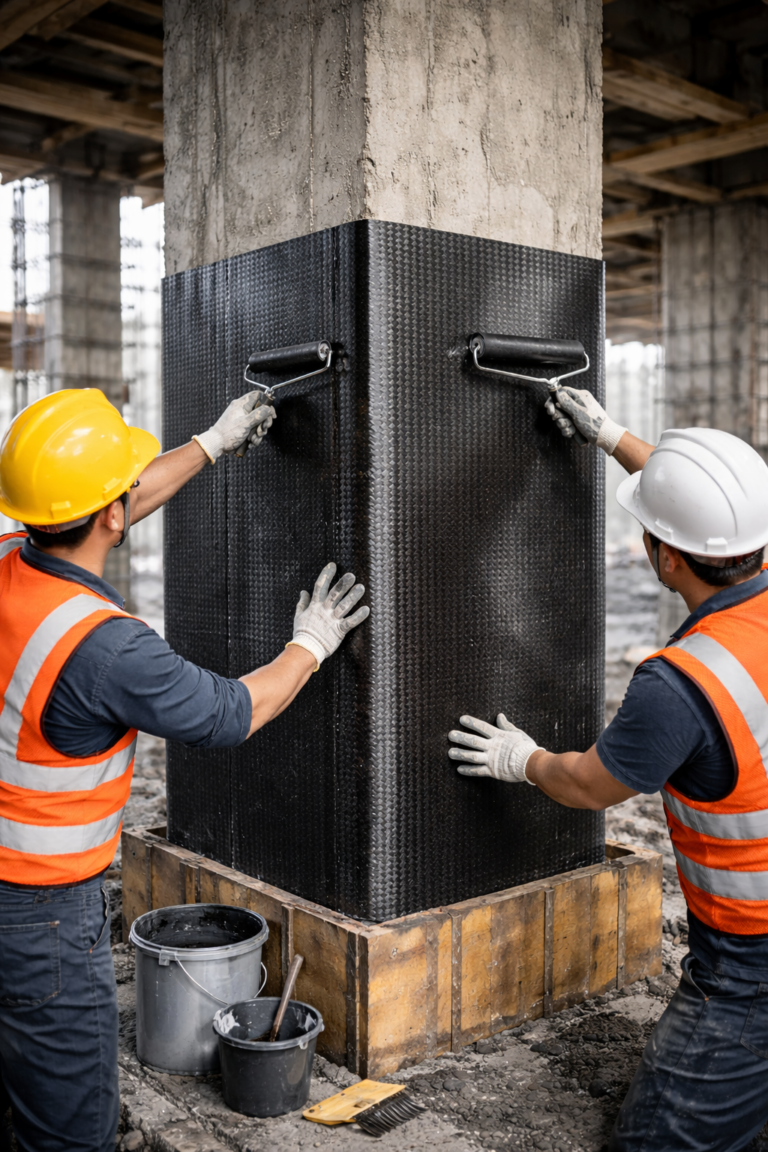
Carbon Fibre Reinforced Polymer (CFRP) strengthening uses high-strength fibre sheets, strips or laminates bonded to the surface of an existing structural member using specially formulated resin systems.
How Carbon Fibre Wrapping Works
CFRP materials are bonded to concrete surfaces to provide additional tensile resistance or confinement, depending on the application and design.
Typical Applications of CFRP Strengthening
- Beam flexural strengthening
- Beam shear strengthening
- Column confinement and strengthening
- Slab strengthening in selected cases
- Lightweight strengthening where space is limited
Advantages of Carbon Fibre Wrapping
- Lightweight strengthening system
- Minimal increase in member size
- Rapid installation in suitable conditions
- High tensile strength
- Useful where architectural clearance is important
- Suitable for selected retrofitting projects
Limitations of Carbon Fibre Wrapping
- Requires sound substrate and careful surface preparation
- Application is sensitive to workmanship and environmental conditions
- Requires engineered detailing and anchorage considerations
- Fire and UV protection may need additional treatment
- Not a universal substitute for conventional strengthening
CFRP systems must be selected and detailed carefully. Their performance depends on substrate quality, bond conditions, orientation of fibres, load path and the structural behaviour intended by the design.
6. Steel Plate Bonding and Steel Strengthening
Steel strengthening methods include steel plate bonding, steel jacketing or the addition of structural steel elements to improve the performance of an existing member.
How Steel Plate Bonding Works
Steel plates may be bonded, bolted or anchored to an existing RCC member in accordance with an approved strengthening design, helping improve flexural, shear or confinement performance where suitable.
Typical Applications of Steel Strengthening
- Beam strengthening
- Column strengthening
- Steel jacketing around existing members
- Strengthening of industrial and infrastructure elements
- Applications where robust mechanical strengthening is required
Advantages of Steel Plate Bonding / Steel Strengthening
- Can provide significant strength enhancement
- Useful in heavy-duty or industrial applications
- Can be combined with anchors or bolts where required
- Well suited to selected retrofitting situations
Limitations of Steel Strengthening
- Adds weight to the structure
- May require corrosion protection
- Requires careful anchorage and connection detailing
- May affect aesthetics or usable space
- Installation can be more intrusive in occupied buildings
Steel systems should be detailed for load transfer, corrosion resistance, connection behaviour and long-term durability.
7. RCC Jacketing vs Carbon Fibre Wrapping vs Steel Plate Bonding
| Parameter | RCC Jacketing | Carbon Fibre Wrapping | Steel Plate Bonding |
|---|---|---|---|
| Material Type | Concrete + steel reinforcement | Fibre composite system | Steel plates / steel sections |
| Increase in Member Size | High | Very low | Low to moderate |
| Additional Weight | High | Very low | Moderate to high |
| Typical Use | Conventional structural strengthening | Lightweight retrofit solutions | Heavy-duty or engineered strengthening |
| Construction Wet Work | Yes | Minimal | Generally limited |
| Speed of Installation | Moderate | Often faster in suitable conditions | Moderate |
| Surface Preparation Requirement | High | High | High |
| Need for Corrosion Protection | Concrete durability considerations apply | Protective measures may be required | Usually yes |
No single method is always the best. The right choice depends on the structural objective, site constraints, budget, architectural limitations and engineering recommendations.
8. How Is the Right Strengthening Method Selected?
Selecting the proper strengthening method requires engineering evaluation rather than a one-size-fits-all approach.
- Condition Assessment: Review cracks, deterioration, load history, drawings and structural condition.
- Define Strengthening Objective: Establish whether the need is for flexural, shear, axial, confinement or seismic improvement.
- Structural Analysis: Determine the required increase in capacity or performance.
- Evaluate Site Constraints: Consider access, available space, occupancy, architectural clearance and working conditions.
- Select Suitable Method: Choose RCC jacketing, CFRP, steel strengthening or a combination of systems based on design needs.
- Prepare Detailed Design & Methodology: Finalise drawings, materials, sequencing, interface treatment and quality requirements.
Practical Reality: Many projects require both repair and strengthening. For example, deteriorated concrete may first need repair before any CFRP, steel or jacketing system can be applied effectively.
9. Typical Applications in Buildings
Residential Buildings and Housing Societies
Structural strengthening in residential buildings is often required for damaged columns, beams, balconies, slabs or areas affected by corrosion and ageing.
Commercial Buildings
Commercial structures may require strengthening due to usage changes, modifications, added services or the need to improve performance of selected members.
Industrial Buildings
Industrial projects may involve strengthening for machinery loads, structural modifications, equipment supports, vibration concerns or rehabilitation of deteriorated RCC members.
Infrastructure and Utility Structures
Selected strengthening methods are also used for tanks, platforms, utility structures and other specialised structural elements, subject to design requirements.
10. Common Execution Considerations
Even the correct strengthening system can fail if it is poorly executed.
Important Execution Factors
- Accurate engineering design and detailing
- Proper surface preparation
- Removal of unsound concrete where required
- Correct reinforcement or anchorage installation
- Material compatibility
- Sequencing and temporary support measures
- Environmental control during application
- Testing, inspection and quality control
- Protection against moisture, corrosion or fire where necessary
Strengthening works should not be treated as ordinary civil finishing works. They require technical supervision, method control and quality documentation.
11. Cost Factors for Structural Strengthening
The cost of strengthening depends on the type of system selected, the extent of strengthening, material quantities and site conditions.
Major Cost Factors
- Extent of structural deficiency
- Member size and number of affected elements
- Selected strengthening method
- Surface preparation and repair requirements
- Access, scaffolding and temporary support
- Specialised materials and labour
- Testing, supervision and quality assurance
- Occupancy constraints and sequencing
| Work Category | Typical Measurement |
|---|---|
| Concrete removal and repair preparation | m² or m³ |
| RCC jacketing concrete and reinforcement | m³ and kg |
| CFRP wrapping / laminates | m² or running metre |
| Steel plates / steel strengthening | kg or item |
| Anchors, bolts and connection work | Number or item |
| Protective coatings / fire protection | m² |
| Scaffolding / access arrangements | m² or lump sum |
BOQ-based quotations are preferable to non-detailed lump sum rates, especially in technically sensitive strengthening works.
12. How to Choose a Structural Strengthening Contractor
Structural strengthening should be executed by a contractor with experience in repair, rehabilitation and strengthening works.
Selection Criteria
- Experience in RCC strengthening projects
- Understanding of jacketing, CFRP and steel systems
- Ability to follow structural engineer's drawings
- Skilled site supervision and trained labour
- Material documentation and quality control
- Safe execution planning
- Transparent commercial and BOQ approach
The contractor should understand not only how to install materials, but also why the strengthening is being carried out.
13. How Structonix Supports Structural Strengthening Projects
Structonix provides specialised structural repair, rehabilitation and strengthening execution services for residential, commercial and industrial buildings.
Our work focuses on implementing approved strengthening methodologies with careful substrate preparation, compatible repair systems, controlled workmanship and project-specific execution planning.
Our Structural Strengthening Services
- RCC jacketing for beams and columns
- CFRP wrapping and strengthening systems
- Steel plate bonding and steel strengthening
- Concrete restoration before strengthening
- Associated waterproofing and protection works
- Strengthening support for residential and industrial projects
Where structural analysis, design or certification is required, the work should be based on the recommendations and approved drawings of a qualified structural engineer.
We consider suitable strengthening and rehabilitation projects across Mumbai, Thane, Navi Mumbai and surrounding areas of Maharashtra.
14. Frequently Asked Questions
Which is better: RCC jacketing or carbon fibre wrapping?
Neither method is universally better. RCC jacketing is a conventional heavy-duty strengthening method, while carbon fibre wrapping is lighter and less intrusive. The correct choice depends on the structural objective, site conditions and engineering design.
Can CFRP replace RCC jacketing in all cases?
No. CFRP is highly useful in many applications, but it is not suitable for every strengthening need. Some projects require RCC jacketing or steel systems to achieve the required performance.
What is steel plate bonding used for?
Steel plate bonding or steel strengthening is used to improve the performance of structural members, particularly where robust engineered strengthening is needed.
Can damaged concrete be strengthened directly?
Not always. Deteriorated or loose concrete usually requires proper repair and preparation before a strengthening system is applied.
Does strengthening increase the life of a building?
Strengthening can improve structural performance, but long-term durability also depends on the condition of existing materials, quality of execution, moisture control and maintenance.
Is structural strengthening expensive?
Costs vary depending on the method, the member size, site conditions and the extent of strengthening required. A technical assessment and detailed BOQ are needed for meaningful cost comparison.
Does Structonix undertake RCC strengthening work in Mumbai?
Structonix provides specialised structural repair and strengthening execution services for suitable residential, commercial and industrial projects in Mumbai, Thane, Navi Mumbai and nearby areas.
15. Conclusion
Structural strengthening methods such as RCC jacketing, carbon fibre wrapping and steel plate bonding are valuable solutions for improving the performance of existing structures.
Each method has a specific role. The most suitable strengthening technique depends on the structural deficiency, required performance, site constraints, construction practicality and the recommendations of the structural engineer.
For building owners, housing societies and industrial clients, the best results are achieved when strengthening is based on proper engineering design and executed by a competent specialist contractor.